
Filling a Gap in Specialty Care
Ehlers-Danlos Syndrome is a connective tissue disorder that remains poorly understood and difficult to treat. Patients living with it often spend years seeking answers, traveling widely to see specialists. The EDS Clinic was founded in 2024 to serve this population directly: offering evaluations, diagnosis, and treatment for patients with EDS and other complex conditions. Founder David Harris was drawn to the work after seeing how his father's allergy practice had become a refuge for patients with complex, overlapping conditions, and how many people were falling through the cracks.
Challenge: Complex and Incomplete Records
Patients arriving at The EDS Clinic rarely bring a complete record. Their histories span years of care across dozens of providers and institutions, scattered across systems that don't talk to each other.
In the early days, the team attempted to use health information exchanges available through their EHR. The coverage was too limited, however, and the portals were too cumbersome to navigate effectively. Clinicians were walking into first appointments with only a fraction of the picture.
Solution: Comprehensive Records Before the First Appointment
When Harris first came across Metriport, the proposition resonated immediately. Metriport provided broad coverage across a population that is notoriously difficult to aggregate records for. With light engineering resources, the no-code dashboard also meant they could get started immediately.
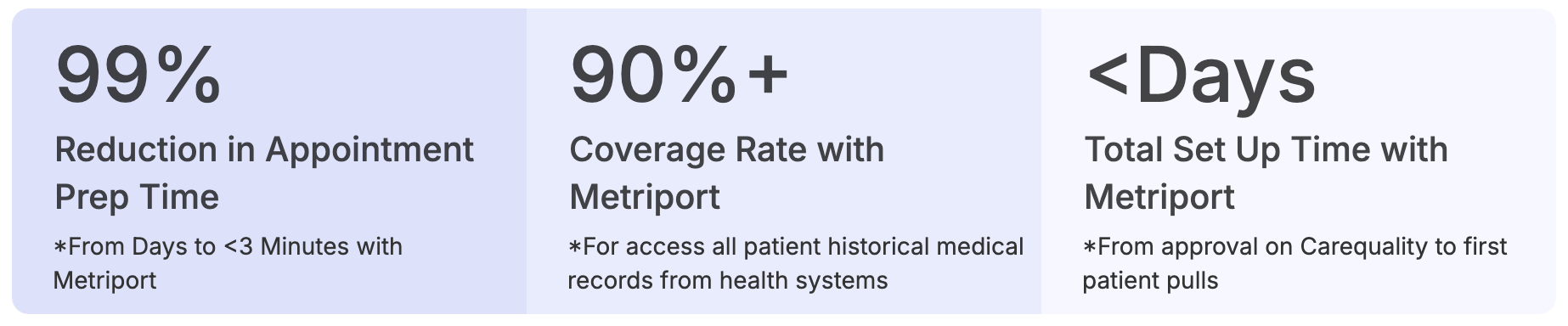
The difference was immediate. Records that previously took days to track down were now available within minutes. The speed alone was a game changer. All of a patient's history populated in a single place, giving clinicians the full context they needed before the visit began.
Results: Fewer Gaps, Better Care
The speed of data retrieval changed how the clinic operates. With records ready in minutes, the team no longer needed to block off preparation days before appointments. That flexibility opened the door to something that wasn't possible before: seeing patients who book last minute.
For a condition like EDS, timely access matters. And the data serves a purpose that reflects the clinic's core philosophy. The EDS Clinic doesn't use patient records to question what patients report. It uses them to add context.
Patients with complex, multi-year histories often can't recall every encounter. Even healthy people forget encounters from years ago. Metriport gives the clinical team a more complete picture, surfacing data points patients may not have on hand and allowing providers to assess and treat with confidence.
Live in Days vs Months
The onboarding experience reinforced the value of the partnership. Metriport's team got EDS Clinic set up within days, managing the Carequality application and network approvals needed to exchange data across major healthcare systems in the US.
“One of the biggest value propositions of Metriport has been the fact that we can always reach out to the team if anything has come up, and they respond right away.”
Changing the Standard of Care for EDS
Today, the standard of care for EDS patients across much of the country is, by the clinic's own account, neglect. Few providers are trained to diagnose it. Fewer still know how to treat it. The EDS Clinic exists to change that, and Metriport is part of what makes it possible.
With complete records in hand, clinicians can incorporate the full scope of a patient's history into every assessment and treatment decision. That's not just operationally useful. For patients who have spent years being dismissed or misdiagnosed, it's the foundation of a different kind of care.